
Medical Affairs Strategy
A Holistic, End-to-End Global Medical Affairs Support Model
EVERSANA helps life sciences teams translate scientific, clinical, and stakeholder insights into an actionable Medical Affairs strategy. Our integrated model connects strategic planning with evidence generation, scientific communications, medical information, field medical, stakeholder engagement, and impact measurement—from Phase II through commercialization and lifecycle management.
Our end-to-end, integrated, customer-centric model is disrupting the medical affairs services industry. With global, future-ready services, we are redefining scientific exchange to drive improved care pathways and optimize patient outcomes.
Unlike the traditional model–seen as a cost center–our model is strategic and directly impacts business KPIs.
The EVERSANA Approach to Medical Affairs Strategy
Rooted in a Strong Foundation of Scientific Evidence
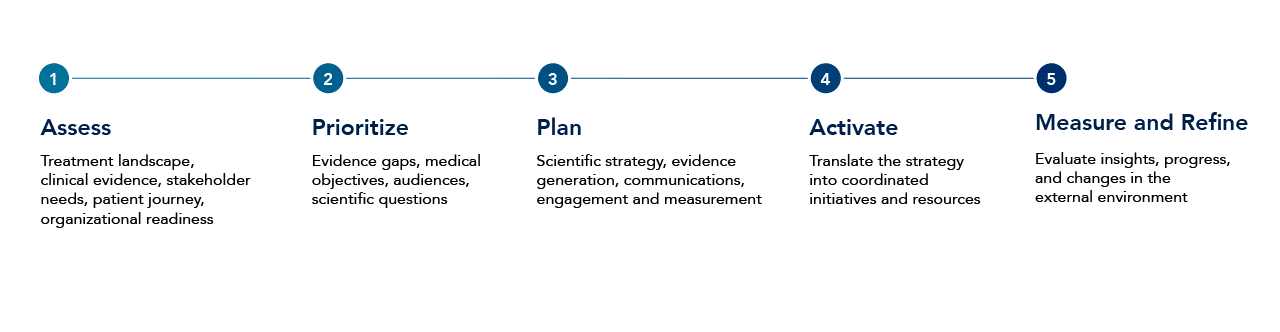
EVERSANA’s Core Medical Affairs Capabilities
A continuum of support and expertise from Phase II through commercialization and lifecycle management.
Strategy and Planning
- Medical strategy and plan development
- Launch planning
- Evidence-gap assessment
- Competitive intelligence and literature evaluation
- Scientific platform and narrative development
- KOL identification and engagement planning
Evidence and Insights
- Evidence-generation planning
- HEOR and real-word evidence (RWE)
- Insights generation and analytics
- Landscape and competitor assessments
- External stakeholder research
- Impact-measurement planning
Scientific Communications and Education
- Publication planning and dissemination
- Congress activities
- Scientific content development
- Medical education and training
- Omnichannel scientific dissemination
Medical Engagement and Operations
- Field medical strategy and deployment
- Medical information
- Advisory boards and expert engagement
- Patient advocacy
- Operational excellence
Technology-enabled Medical Affairs
- Medical portals
- Medical chatbots and digital inquiry channels
- AI-supported content workflows
- Medical and regulatory review support
- Medical insights platforms
Medical Affairs Strategy Across the Product Lifecycle
Phase II
Build the scientific foundation
- Assess the treatment and evidence landscape
- Identify unmet evidence and stakeholder needs
- Inform the target product profile
- Begin scientific platform and narrative development
- Align Medical Affairs with clinical development
Phase III / Pre-launch
Prepare for scientific exchange
- Develop the medical strategic plan
- Refine evidence-generation priorities
- Plan publications and congress activities
- Identify and understand external stakeholders
- Prepare medical information and field medical resources
- Define medical impact measures
Launch
Activate the strategy
- Enable field medical scientific exchange
- Coordinate congress and publication activities
- Respond to medical information needs
- Capture and analyze stakeholder insights
- Update evidence and engagement priorities
Post-launch
Learn and adapt
- Identify new evidence gaps
- Support real-world evidence and HEOR programs
- Refine scientific communications
- Inform lifecycle planning
- Evaluate medical impact and adjust the plan
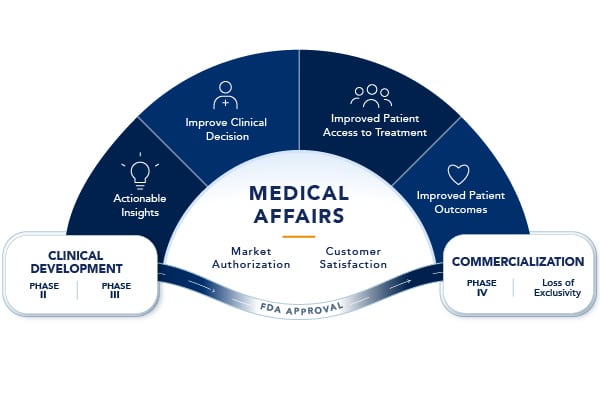
The Bridge Between Clinical Development and Commercialization
By engaging in a Medical Affairs partnership with EVERSANA as early as Phase II, we help:
- Support the design of your ideal product profile that addresses unmet need
- Structure trials to meet the objectives of your product profile
- Define your product’s value
- Collect data and drive subsequent insight generation
- Develop the corresponding medical and commercial strategy
Medical Affairs Strategy Versus Activation and Deployment

Medical Affairs Strategy
Medical Affairs Strategy defines the medical vision, priorities and decision framework. It determines the evidence needs, stakeholder needs, scientific narrative, medical objectives, strategic initiatives and measures of impact that will guide the function.

Medical Strategy Activation
Medical Strategy Activation translates the strategy into coordinated programs, content, and engagement plans. Activation may include evidence-generation planning, publications, congress strategy, scientific communications, medical education, medical information planning, and stakeholder engagement.

Field Medical Deployment
Field Medical Deployment provides the infrastructure and qualified medical professionals needed to conduct compliant, non-promotional scientific exchange, gather field insights, and execute defined field medical activities.
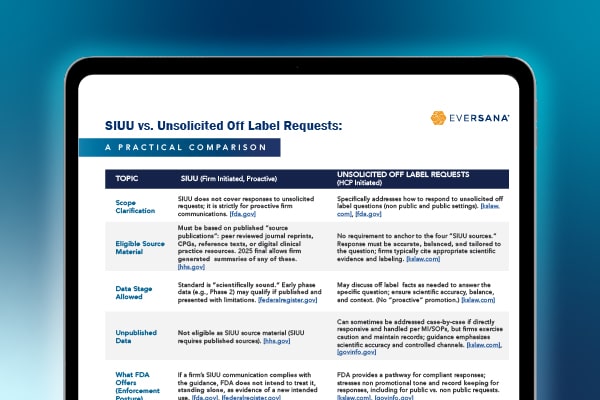
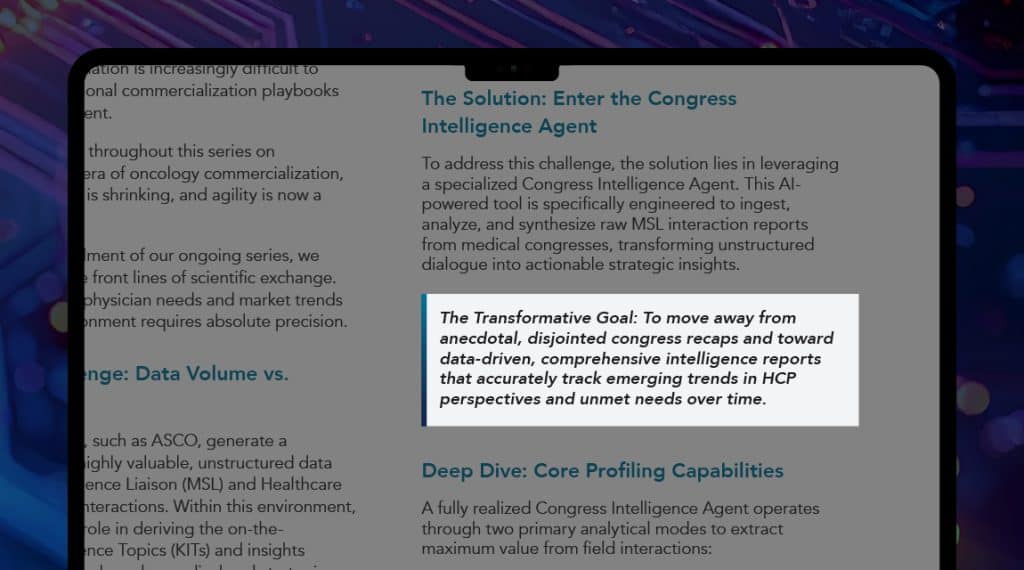
Explore Medical Affairs Thought Leadership




Schedule a meeting with our Medical Affairs experts today
Frequently Asked Questions
What is Medical Affairs strategy?
A Medical Affairs strategy is an evidence-led plan that guides how life sciences organizations identify evidence gaps, generate and communicate scientific evidence, engage external stakeholders, and measure medical impact across the product lifecycle. It aligns medical objectives with clinical development, patient needs, healthcare decision-making, and the responsible use of a therapy in clinical practice.
What should a Medical Affairs strategy include?
A Medical Affairs strategic plan typically includes the situation analysis, unmet medical and evidence needs, medical objectives, priority stakeholders, scientific communication priorities, evidence-generation plan, engagement strategy, cross-functional dependencies, implementation roadmap, and measures of medical impact.
A Medical Affairs strategic plan should define:
- What the organization needs to learn: evidence gaps, stakeholder needs and changes in the treatment landscape
- What the organization needs to accomplish: prioritized medical objectives tied to patient and scientific needs
- How the strategy will be activated: evidence generation, scientific communications, medical education and stakeholder engagement
- How success will be measured: indicators of scientific understanding, stakeholder engagement, organizational learning and medical impact
When should Medical Affairs planning begin?
Medical Affairs planning may begin as early as Phase II, when teams can start assessing the treatment landscape, identifying evidence needs, developing the scientific narrative, and preparing for future stakeholder engagement. The appropriate starting point depends on a variety of factors, including the asset, indication, development plan, evidence base, and launch objectives.
How does Medical Affairs strategy look across the product lifecycle?
Phase II: Build the scientific foundation
- Assess the treatment and evidence landscape
- Identify unmet evidence and stakeholder needs
- Inform the target product profile
- Begin scientific platform and narrative development
- Align Medical Affairs with clinical development
Phase III and pre-launch: Prepare for scientific exchange
- Develop the medical strategic plan
- Refine evidence-generation priorities
- Plan publications and congress activities
- Identify and understand external stakeholders
- Prepare medical information and field medical resources
- Define medical impact measures
Launch: Activate the strategy
- Enable field medical scientific exchange
- Coordinate congress and publication activities
- Respond to medical information needs
- Capture and analyze stakeholder insights
- Update evidence and engagement priorities
Post-launch and lifecycle management: Learn and adapt
- Identify new evidence gaps
- Support real-world evidence and HEOR programs
- Refine scientific communications
- Inform lifecycle planning
- Evaluate medical impact and adjust the plan
How is Medical Affairs strategy different from commercial strategy?
Medical Affairs strategy focuses on scientific evidence, unmet medical needs, non-promotional scientific exchange, and informed healthcare decision-making. Commercial strategy focuses on market positioning, customer strategy, and business performance. The functions should coordinate where appropriate while maintaining distinct objectives, governance, and responsibilities.
What role does Medical Affairs play after launch?
Post-launch Medical Affairs continues to identify evidence gaps, support scientific exchange, analyze stakeholder insights, contribute to real-world evidence and HEOR planning, update medical content, and inform lifecycle priorities. The function also helps the organization respond to changes in clinical practice, available evidence, and the treatment landscape.
How should the impact of Medical Affairs be measured?
Measurement should connect activities to defined medical objectives. Depending on the program, indicators may include progress against evidence-generation priorities, scientific engagement quality, identified and addressed knowledge gaps, stakeholder insights, content use, organizational learning, and changes in scientific understanding. Measures should be established during strategy development rather than added after execution begins.
Why work with an external Medical Affairs strategic partner?
An external partner can provide specialized expertise, additional capacity, an outside perspective, and coordination across strategy and execution. The right model depends on internal capabilities and may range from targeted advisory support to an integrated approach spanning evidence, scientific communications, medical information, field medical, and measurement.