
Nearly a year after the executive order to implement Most Favored Nation (MFN) drug pricing policy in the U.S., clear strategic pictures are emerging, including:
- Launch prices in Europe that are higher than launch prices in the U.S.
- Prices in Japan that are 90-100% lower than the U.S.
- Longer launch timelines outside the U.S.–with wildly varying outcomes
- Impacts of MFN on licensing agreements–also with varying outcomes
- Payer responses aimed to accommodate more flexible pricing–but are they coming too late?
With over 200 weekly clients, NAVLIN Insights’ MFN Tracker has quickly become the leading resource for decoding the impact of MFN on the pharmaceutical sector. This month, we are launching an MFN Executive Summary to provide a high-level strategic digest as a companion to the more detailed, analytical view in the tracker.
Powered by NAVLIN Price & Access Data, which has been cited as a source by the U.S. CMS, the MFN Tracker includes:
- Launch Timing Benchmarks by Market
While many companies, trade associations, and even payers are warning that MFN is delaying launches for new medicines outside the U.S., there have been only a handful of specific public announcements. In the absence of formal disclosure, we track what the data itself is telling us–highlighting unusual time to launches that appear to indicate MFN-related delays, as well as very quick, in-line launches that suggest minimal MFN exposure perhaps due to mitigating factors such as tariff deals signed with the U.S. administration. - Price Differentials Between U.S. and ex-U.S.
What is the data actually telling us about list price trends and payer willingness to negotiate higher list prices to protect U.S. prices? For example, we hear publicly that Japan may be willing to accommodate higher list prices to protect against MFN; yet, the data continues to show 90-99% discounted prices in Japan relative to the U.S. - Trade-offs Between Launch Timing and Global Price Differentials
Clear trade-offs are emerging between time to launch and U.S.-ex-U.S. pricing differentials. We observe cases where time to launch is longer than usual (100+ days) but with very different outcomes. In some cases, price differentials remain in-line with pre-MFN levels–indicating interim period minimization of MFN impact in the U.S. In others, launch prices in Europe now exceed those in the U.S.–a fundamentally different outcome under MFN pressure. - Emerging Cases Studies on MFN’s Impact on Licensing Agreements
The tracker highlights examples where licensed asset launch price differentials between U.S. and Germany or Japan are as large as, or even larger than, pre-MFN levels, as well as examples where price differentials are much narrower. Together, these help identify scenarios where ex-U.S. license agreements can be destructive to U.S. pricing and asset value for firms that have maintained U.S. commercialization rights. - Global Policy Responses to MFN
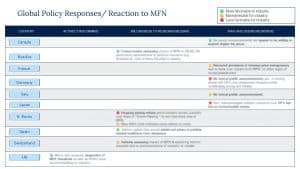
Finally, the tracker categorizes global policy responses to MFN by level and type of industry impact. Many governments are announcing a “review” of their existing pricing and access systems, thinly disguised as concerns over the impact of MFN. The clear focus is on price transparency and ensuring that markets are still attractive to new, innovative medicines. However, many of these are not expected to see any concrete impact until 2027 or later. This raises a key strategic question: are temporary, interim, or more creative measures feasible during the interim period?
Please contact us today to get access to the MFN Tracker!
Author Team

NAVLIN Insights gives you an advanced set of capabilities, frameworks, and methods. These are all derived from a robust stakeholder panel, providing critical answers to your specific payer marketing and market access questions. Learn…