
“The future of HEOR is not about producing more analyses. It is about creating a better system for generating, maintaining, and applying evidence.”
A More Connected Model for HEOR
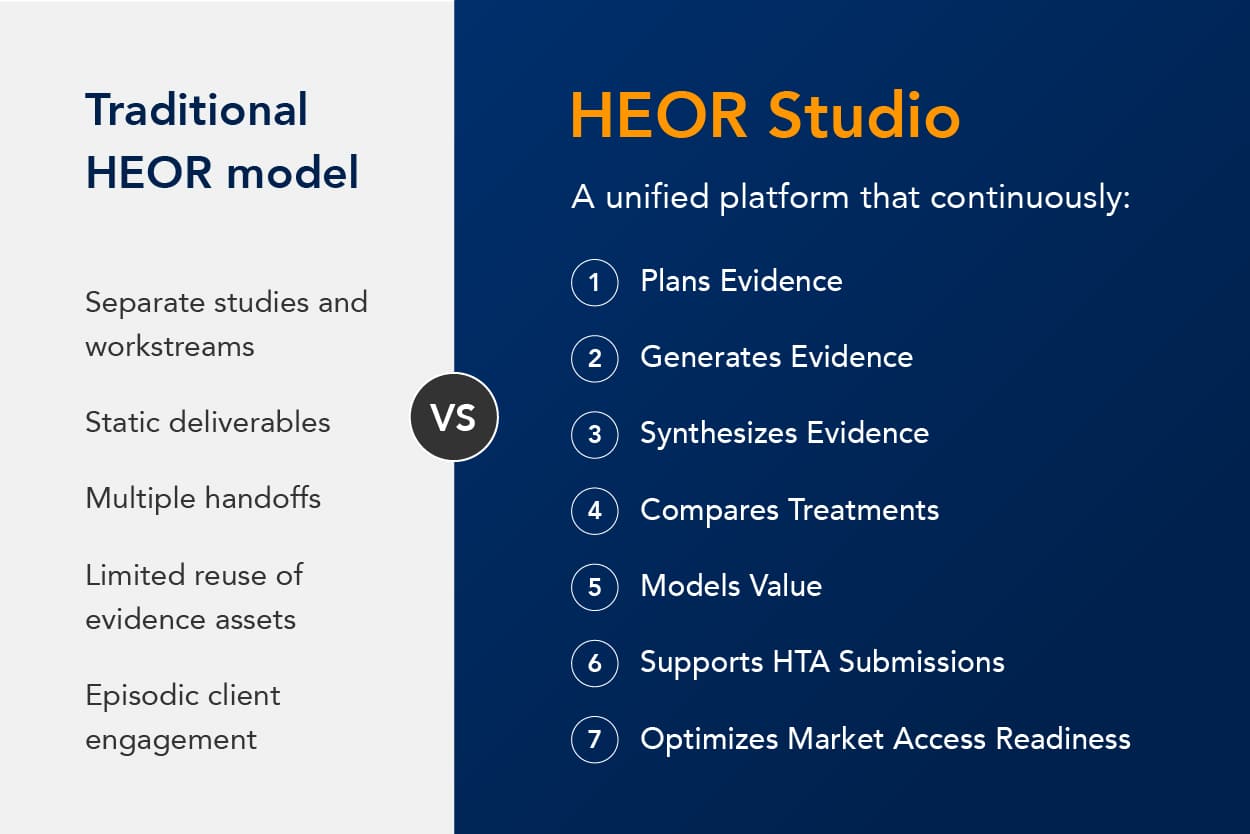
HEOR has traditionally been organized around discrete projects: a literature review, an evidence synthesis, an economic model, a value dossier, and an HTA submission. Each deliverable answers an important question, but the evidence underlying those deliverables often remains fragmented across teams, workflows, and static files.
That model was built for a more linear environment. Today, evidence changes continuously, access requirements evolve across markets, and organizations must answer payer and HTA questions with greater speed and consistency. Evidence and assumptions may still be transferred through handoffs, recreated across workstreams, or embedded in static files that are difficult to maintain and reuse.
As evidence requirements expand and decision-making timelines accelerate, this project-by-project model is becoming harder to sustain. Organizations must update evidence more frequently, respond to stakeholder questions more quickly, and maintain consistency across a growing portfolio of interdependent assets. Fragmentation can delay the identification of access-critical evidence gaps, create inconsistencies across clinical and economic value narratives, and leave teams responding to payer and HTA questions too late.
The challenge is no longer only to generate evidence. It is creating a connected and responsive system that keeps evidence current, consistent, and ready to inform decisions throughout the product lifecycle.
That is the opportunity behind HEOR Studio.
Why HEOR Needs a New Model
Today’s HEOR environment is increasingly complex.
A single asset may require evidence generation plans, literature reviews, indirect treatment comparisons, economic models, real-world evidence studies, payer value stories, publication strategies, and HTA submissions. Each activity creates valuable information, but much of that information remains trapped within individual projects.
As a result, organizations often face common challenges:
- Repeating work across multiple evidence activities
- Updating analyses when new data emerge
- Maintaining consistency across evidence assets
- Tracking evolving payer and HTA requirements
- Connecting evidence to market access and commercialization decisions
These challenges are not only operational. They can affect how early organizations identify access-critical evidence needs, how consistently they communicate clinical and economic value, and how effectively they prepare for payer and HTA decision-making.
In our view, improving the speed of individual HEOR activities will not be enough. Organizations must also change how evidence is connected, governed, and maintained across activities. Otherwise, faster production may simply create more disconnected outputs.
What Is HEOR Studio?
HEOR Studio is our vision for connecting the core components of evidence generation within a shared digital environment – supported by scientific expertise, standardized workflows, and AI-enabled capabilities.
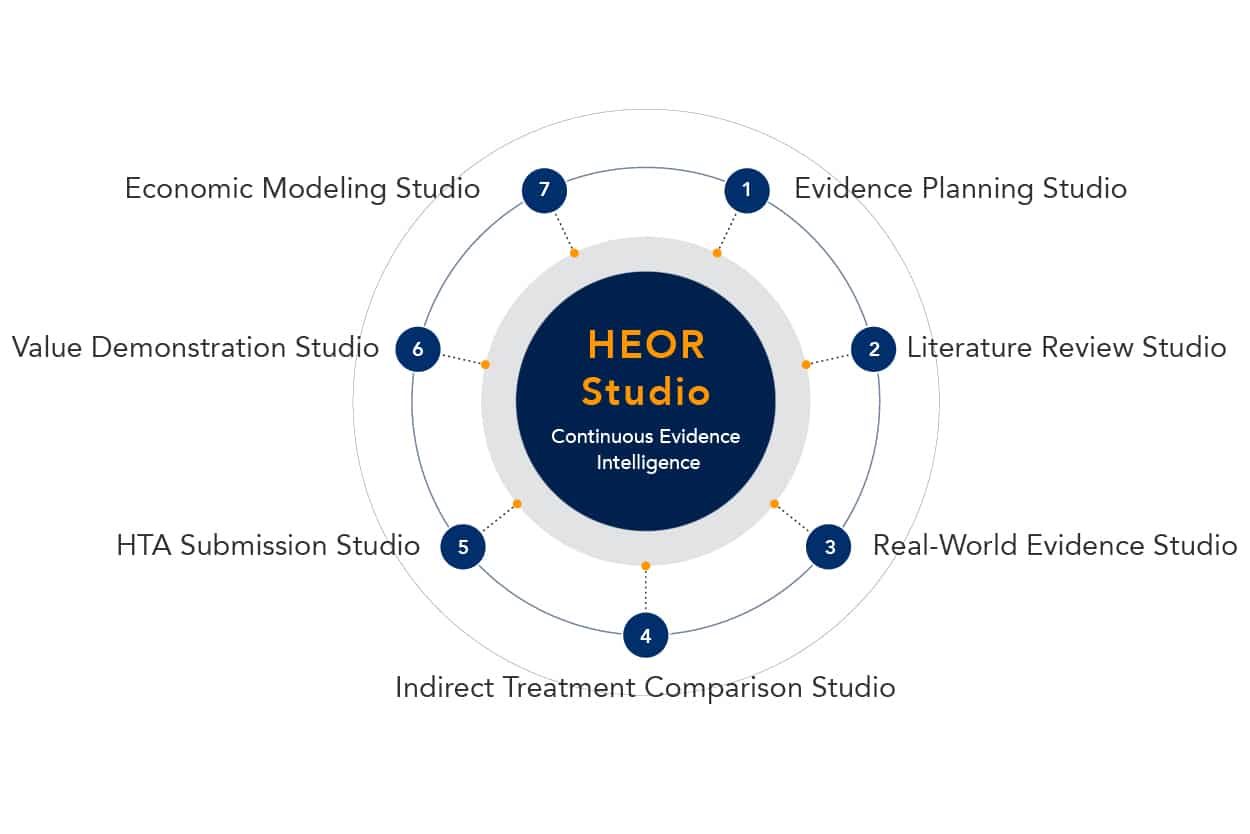
Rather than viewing HEOR as a collection of separate deliverables, HEOR Studio treats evidence as a continuously evolving asset that can be monitored, updated, and applied throughout the product lifecycle.
Across that workflow, HEOR Studio enables five core capabilities:
- Continuously Monitor the Evidence Landscape
Evidence generation should not begin when a project starts and end when a report is delivered. HEOR Studio is designed to help teams monitor evolving evidence landscapes, track new publications, identify emerging competitors, and understand how evidence is changing over time. Instead of asking: “Can you conduct a literature review?” Organizations may increasingly ask: “What has changed in the evidence landscape since our last review?” - Accelerate Evidence Synthesis
Systematic reviews, network meta-analyses, and indirect treatment comparisons remain foundational HEOR activities. HEOR Studio aims to make these activities more efficient by helping teams identify relevant evidence, organize information, and accelerate evidence synthesis workflows while maintaining scientific rigor. The goal is not to replace experts but allow experts to focus more of their time on interpretation, strategy, and decision-making. - Maintain Living Evidence Assets
Many evidence assets become outdated almost as soon as they are completed. Economic models require updates. Evidence syntheses need refreshing. Payer value messages evolve as new data emerges. HEOR Studio is designed around the idea of maintaining living evidence assets rather than creating static deliverables. This allows organizations to respond more efficiently when new evidence becomes available and helps ensure that critical decisions are based on the most current information.
“The most valuable evidence asset may no longer be a report. It may be the system that keeps that report continuously current.”
- Improve HTA and Market Access Readiness
Evidence generation is ultimately intended to support decisions about value and access. As HTA requirements evolve and timelines accelerate, including the introduction of European JCA, organizations need to anticipate the populations, comparators, outcomes, subgroups, and economic questions that will shape assessment. Earlier visibility across evidence assets can help teams identify access-critical gaps, align global evidence plans with HTA decision problems, and distinguish issues that are informational from those that could materially affect reimbursement readiness. HEOR Studio helps connect evidence generation with value narratives and HTA preparation within a traceable evidence foundation. This supports more consistent assumptions across assets, more efficient adaptation to local requirements, and faster responses to clarification questions, appraisal concerns, negotiations, and reassessments. The objective is not to guarantee reimbursement outcomes, but to improve the readiness, responsiveness, and consistency with which organizations support reimbursement decision-making.
“As evidence requirements become more demanding, success will depend on anticipating evidence needs, not simply responding to them.”
- Connect Evidence to Commercialization
Evidence does not exist in isolation. Evidence influences market access strategies. Market access decisions influence commercialization activities. Commercial insights can help inform future evidence generation priorities. One of the most exciting aspects of the HEOR Studio vision is the opportunity to connect these activities within a broader commercialization ecosystem. Combined with capabilities such as NAVLIN by EVERSANA, NAVLIN Access Studio, EVERASNA’s AI Agency platform, and Agentic Data capabilities, HEOR Studio can help create stronger connections between evidence, access, and commercialization.
Building a Connected, AI-enabled Commercialization Ecosystem
Together, these capabilities create the foundation for a more connected AI-enabled commercialization ecosystem.
At its core is an Evidence Engine that continuously monitors, synthesizes, updates, and applies evidence across the product lifecycle. Rather than replacing individual HEOR methods or deliverables, the Evidence Engine connects them through a shared foundation that supports ongoing learning, decision-making, and value demonstration.
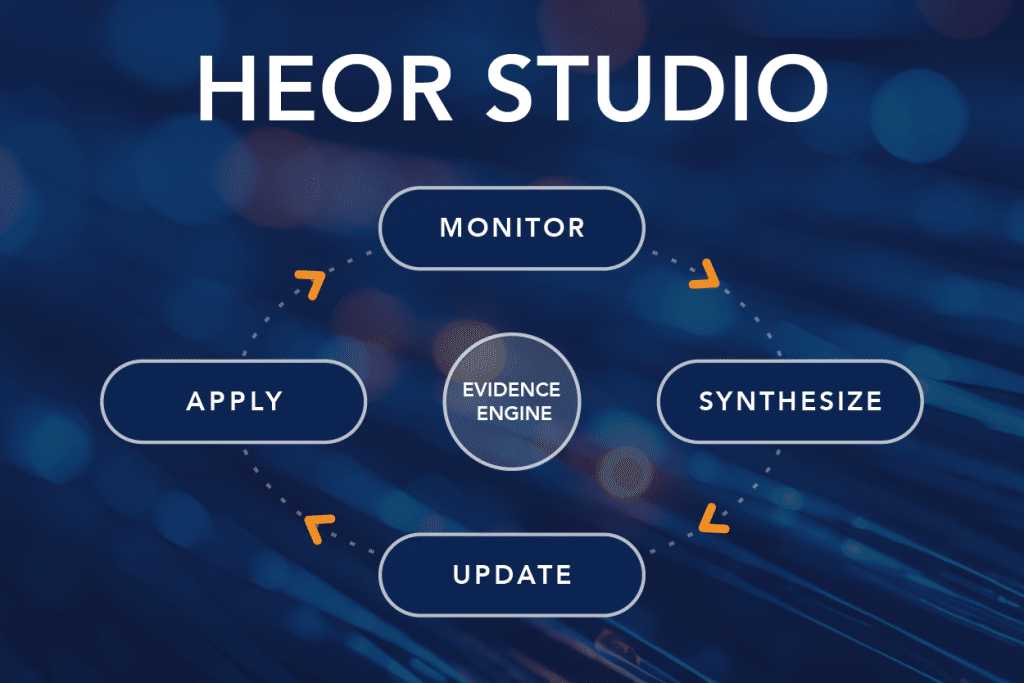
The opportunity also extends beyond HEOR. When evidence is connected with market access, pricing, commercialization, payer intelligence, and AI-enabled engagement capabilities, it can become a consistent strategic input to decisions across the product lifecycle.
For clients, the benefits are clear:
- Earlier identification and prioritization of access-critical evidence gaps
- Stronger alignment of evidence plans with payer, JCA, and national HTA requirements
- Greater consistency across clinical evidence, economic models, value narratives, and submission assets
- Faster, more traceable responses to payer and HTA questions
- Improved launch, reimbursement, and reassessment readiness across markets
- Reduced evidence duplication and more efficient adaptation of evidence assets across jurisdictions
Most importantly, it helps teams spend less time recreating and reconciling information and more time anticipating access requirements, interpreting uncertainty, and applying expertise to the decisions that shape value and reimbursement.
“The long-term opportunity is to not only build better HEOR tools, but to create a connected evidence ecosystem that links evidence, access, and commercialization across the product lifecycle.”
Looking Ahead
HEOR has always been about helping decision-makers navigate uncertainty using the best available evidence. While that mission remains unchanged, the volume, complexity, and pace of evidence generation continue to increase.
HEOR Studio represents a move toward that connected model. By bringing evidence planning, generation, synthesis, economic modeling, value demonstration, and HTA preparation into a shared environment, it can help organizations anticipate access-critical evidence needs earlier and respond to decision-makers with greater consistency and traceability.
The objective is not to replace scientific expertise, but to amplify it. When experts spend less time recreating and reconciling information, they can spend more time interpreting uncertainty, anticipating stakeholder needs, and strategically applying evidence to the decisions that shape value, access, and outcomes for patients.
Author


Dr. Chris Cameron is a global thought leader in health economics and outcomes research with over a decade of experience. Prior to joining EVERSANA, Chris was a partner at Cornerstone Research Group Inc., and…

As a health economist with over 15 years of experience, Heather has led global health economic and market access programs, as well as local reimbursement projects involving economic modeling, evidence generation, strategy and value communication.…

Nicole directs U.S. and global projects to support multi-stakeholder medical device adoption and reimbursement. Nicole has more than 20 years of experience in health economics and research methods within academic, industry, and consulting roles.…